Seagate Technology Holdings is a provider of data storage technology and solutions. Co.'s principal products are hard disk drives (HDDs). In addition, Co. produces a range of data storage products including solid state drives (SSDs) and storage subsystems and provides storage solutions such as a edge-to-cloud mass data platform that includes data transfer shuttles and a storage-as-a-service cloud. Co. provides a range of storage solutions for mass capacity storage which includes: Enterprise Nearline HDDs, Enterprise Nearline SSDs, Enterprise Nearline Systems, Video and Image Applications and Network-attached storage.
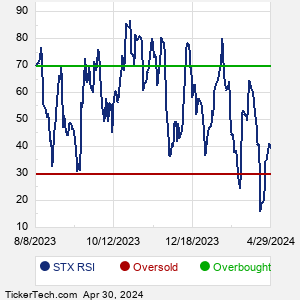
When researching a stock like Seagate Technology, many investors are the most familiar with Fundamental Analysis — looking at a company's balance sheet, earnings, revenues, and what's happening in that company's underlying business. Investors who use Fundamental Analysis to identify good stocks to buy or sell can also benefit from STX Technical Analysis to help find a good entry or exit point. Technical Analysis is blind to the fundamentals and looks only at the trading data for STX stock — the real life supply and demand for the stock over time — and examines that data in different ways. One of these ways is called the Relative Strength Index, or RSI. This popular indicator, originally developed in the 1970's by J. Welles Wilder, looks at a 14-day moving average of a stock's gains on its up days, versus its losses on its down days. The resulting STX RSI is a value that measures momentum, oscillating between "oversold" and "overbought" on a scale of zero to 100. A reading below 30 is viewed to be oversold, which a bullish investor could look to as a sign that the selling is in the process of exhausting itself, and look for entry point opportunities. A reading above 70 is viewed to be overbought, which could indicate that a rally in progress is starting to get crowded with buyers. If the rally has been a long one, that could be a sign that a pullback is overdue. |


 38.82
38.82


 Free STX Email Alerts:


 Video: RSI Indicator